






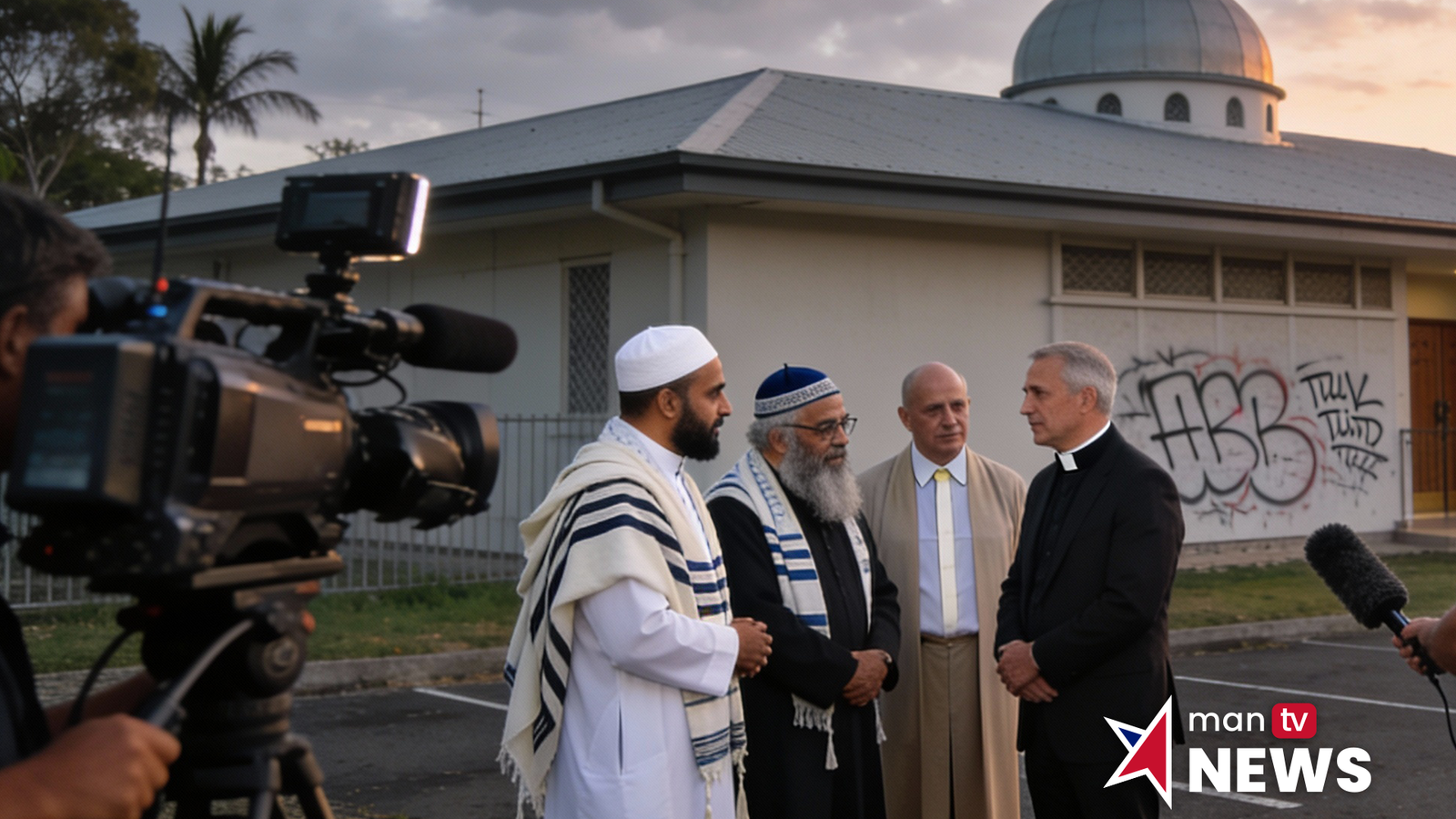
We Choose Unity” Bald Hills Mosque, Jewish Community Navigate Fear and Faith After Hate Attacks
Brisbane, Friday 26 December 2025 As worshippers gather today for the first Friday prayers after Christmas, leaders across Brisbane’s Muslim and Jewish communities are balancing grief, fear and determination in the wake of two jarring hate incidents: the swastika‑laden vandalism of Bald Hills Mosque and the antisemitic terror attack at a Hanukkah celebration on Bondi Beach.
At Bald Hills Mosque in Brisbane’s north, early morning worshippers on 18 December were met with a confronting scene a large Nazi swastika and phrases including “No Muslims = peace” and “F**k Allah” sprayed across an exterior wall. Security footage captured a masked figure approaching the building under cover of darkness and fleeing after defacing the mosque, prompting a hate crime investigation by Queensland Police.
Officers believe the vandal struck between 8pm Wednesday and 3am Thursday, with the graffiti discovered by congregants arriving for dawn prayers. The incident falls under Queensland laws that made it illegal last year to publicly display Nazi hate symbols, and the state Attorney General has signalled that the government is now considering expanding the ban to other extremist symbols.
“Everyone deserves to feel safe”
Sandgate MP Bisma Asif, Queensland’s first Muslim woman elected to state parliament, condemned the attack in a strongly worded social media statement that has since been widely shared. She said the vandalism came “on the back of 15 innocent people losing their lives at the hands of extremists in an antisemitic attack on Sunday” at Bondi Beach, and called out a pattern of “constant antisemitic, Islamophobic and racist incidents” across the community.
“Everyone in our community deserves to feel secure in their homes, places of worship, and workplaces,” Asif said, urging Queenslanders to “stand together” against those trying to divide them. Australian Test cricketer Usman Khawaja reshared her message on Instagram, adding his own plea: “Don’t let the haters divide us,” amplifying the call for unity far beyond Brisbane’s northside.
Brisbane’s Lord Mayor Adrian Schrinner echoed that sentiment in a video message, describing the vandalism at Bald Hills Mosque as “wrong” and out of step with the city’s values. He stressed that Brisbane is a multicultural city where freedom of religion must be protected, a theme that has featured prominently as community leaders prepare to address worshippers at today’s Friday prayer gatherings.
Interfaith solidarity on the mosque steps
In the days after the attack, clergy and staff from the Anglican Church Southern Queensland visited Bald Hills Mosque, standing alongside imams and local Muslim families in a public gesture of friendship. The faith leaders shared prayers and conversations on the mosque grounds, with Anglican representatives describing the visit as a tangible way to “show up” for Muslim neighbours after the masjid was targeted.
That interfaith response has been mirrored on the airwaves and online, where community figures have framed the attack not just as an assault on Muslims, but as a strike against Brisbane’s broader multicultural identity. A widely shared TV segment showed northside leaders condemning the anti Islam graffiti and vowing that the mosque – also known as Masjid Taqwa would remain a place of peace, learning and community support.
Queensland Police have stepped up patrols around the mosque and deployed a mobile police unit during at least one gathering, a visible reassurance that is expected to continue around Friday prayers while the investigation remains open. Officers are urging anyone with information about the masked offender to contact police, as they work through CCTV and witness reports.
Jewish community in a “heightened state of security”
For Queensland’s Jewish community, the Bald Hills incident lands just days after the antisemitic mass shooting at a Hanukkah celebration on Bondi Beach, where 15 people were killed and dozens injured. The attack, which authorities have classified as a terrorist act aimed at Jewish attendees, sent shockwaves through Jewish communities nationwide and prompted an urgent review of security arrangements.
The Queensland Jewish Board of Deputies (QJBD) confirmed that, in consultation with police, all public Hanukkah events across the state were cancelled on the Monday following the attack. QJBD president Jason Steinberg said the community is in a “heightened state of awareness and security,” welcoming additional police presence at synagogues and calling on the wider public to be “thoughtful” around Jewish places of worship.
In Brisbane, bridges and civic landmarks were dimmed, then lit up, in tribute to the Bondi victims, with the Lord Mayor declaring that the city “chooses light over darkness.” The symbolism has carried through to private and communal gatherings this week, as Jewish leaders emphasise resilience and solidarity while grappling with very real safety concerns.
One story of hate, two communities at risk
The defacing of Bald Hills Mosque with Nazi imagery has sharpened a painful reality: symbols of antisemitic hatred are now being deployed in public attacks on Muslims as well. Analysts and community advocates say the same extremist ideologies that fuel violence against Jews are also driving Islamophobic abuse, and that failing to confront one form of hatred ultimately feeds the other.
Human rights organisations have warned that both antisemitism and Islamophobia are rising in Australia, urging governments to treat the protection of religious minorities as a core democratic obligation. The Australian Human Rights Commission noted this month that rhetoric and conspiracy theories circulating online are creating a permissive environment for real‑world violence, calling for stronger leadership and community education.
For many Brisbane residents, the events of December have reinforced an uncomfortable truth: while multiculturalism remains a defining strength, it cannot be taken for granted. It must be actively defended in parliaments, at police command posts, and on the steps of mosques and synagogues.
Watching today’s prayers and what comes after
As Muslims arrive for Jumu’ah prayers at Bald Hills Mosque today, they will do so under the watchful eye of police and the quiet support of neighbours from other faiths. Community leaders are expected to use sermons and post‑prayer gatherings to re‑affirm messages of calm, dignity and unity, even as families remain shaken by the imagery that briefly turned their sacred space into a canvas for hate.
Across town, Brisbane’s synagogues will also be operating under enhanced security, with leaders continuing to review threat assessments after Bondi and urging congregants to stay vigilant while holding fast to traditions of worship and community life. Behind the scenes, Jewish and Muslim organisations are in regular contact with Queensland Police and other authorities, providing feedback and advocating for measures that protect all communities equally.
What happens next whether the Bald Hills offender is caught, whether online rhetoric cools or intensifies, whether political leaders follow through on promises to strengthen protections will shape how safe Brisbane’s minority faith communities feel in the months ahead. But for now, the message from the mosque courtyard and the synagogue foyer appears remarkably similar: grief is real, fear is understandable, and yet the only sustainable answer to hate is a deeper commitment to stand together.


 English