






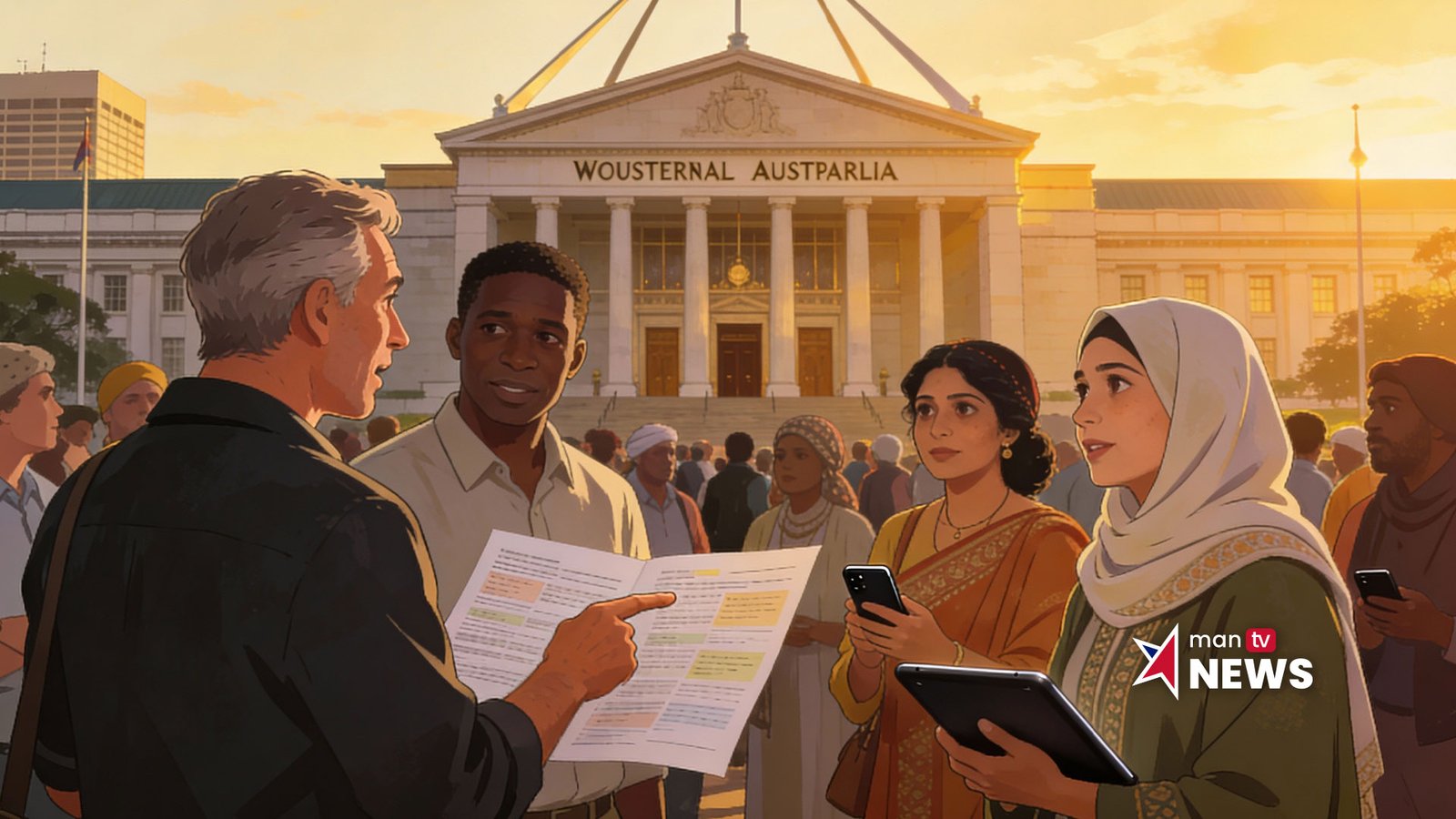
Western Australians invited to help shape state’s first Multicultural Act
The Cook Government has launched public consultation on a proposed Multicultural Act for Western Australia, with community members given until 15 February 2026 to help decide how multicultural principles should be written into law for the first time in the state.
Western Australians are being asked to help design a landmark Multicultural Act that would formally recognise the state’s cultural diversity in law and guide how government policies, services and decisions are delivered in the years ahead. Public consultation is now open and will run until Sunday 15 February 2026, with residents able to contribute via an online discussion paper, survey and written submissions.
The initiative is being led by the Office of Multicultural Interests (OMI), which has released a detailed discussion paper and supporting research outlining why an Act is being considered and what it could contain. The paper notes that more than 32 per cent of Western Australians were born overseas, with more than 249 languages spoken and over 130 religions followed across the state, and argues that this level of diversity warrants clear, legislated recognition. It frames the proposed law as a way to move multicultural commitments from aspiration to obligation, embedding principles of inclusion, fairness and participation across government.
If adopted, a WA Multicultural Act would enshrine in law the progress already made under existing policies such as the WA Multicultural Policy Framework, ministerial advisory arrangements and community language programs. The Cook Government and OMI say a legislated framework could encourage greater investment in multicultural initiatives, improve the cultural competence of public services in areas like health, justice and education, and support education programs that build intercultural understanding. It is also expected to strengthen accountability, with research from other states highlighting the impact of mandatory reporting requirements on how agencies plan for and deliver services to culturally and linguistically diverse communities.
The consultation comes as Western Australia approaches its bicentenary in 2029, a moment the discussion paper describes as an opportunity to reflect on the state’s migration history and the contribution of successive waves of settlers and refugees to social, cultural and economic life. The research underpinning the process emphasises that WA already has a substantial policy effort in place: as of September 2025, 64 public sector agencies were implementing multicultural plans with 4,830 specific actions committed across service delivery, participation and inclusion, nearly half of which had already been completed. The proposed Act is framed as a way to formalise and protect this work over the long term, rather than replace it.
A key focus of the discussion paper is the distinct status of Aboriginal peoples as the First Peoples of Western Australia. It stresses that First Nations communities and people from migrant and refugee backgrounds have different histories and starting points, and that any legislative framework must recognise these differences while supporting equity across the broader population. The paper also canvasses whether existing multicultural advisory arrangements should be written into law, citing evidence from other jurisdictions that legislated councils and advisory bodies can strengthen trust and ensure consultation is ongoing, structured and tied to real decision-making.
Western Australia is currently the only large mainland state without multicultural legislation, with Victoria, New South Wales, Queensland and South Australia all operating under Acts that set out principles, define agency responsibilities and require regular reporting to Parliament. Research commissioned for the WA process finds that these laws have helped move commitments into practice by introducing clear accountability mechanisms, whole-of-government reporting and formal advisory structures. In some states, such as Victoria and New South Wales, local governments are also drawn into formal reporting and planning, improving visibility of regional and rural needs and reducing a purely metropolitan focus — an approach the WA discussion paper suggests could deliver similar benefits if adopted.
Beyond governance, the research links multicultural legislation with stronger, more coordinated responses to racism and social tension. Jurisdictions with Acts in place report clearer lines of responsibility between agencies during periods of community stress and better-defined pathways for reporting and addressing incidents, supported by legislated principles and reporting frameworks. The WA consultation asks the public how such responsibilities should be structured in any new law, and what tools communities need to feel safe, respected and able to participate fully in civic life.
Members of the public can provide feedback on the proposed Act through an online survey or by lodging written submissions via the OMI website, with support available for people who require interpreting services or translated material. A summary of submissions is expected to be released around April 2026, followed by development of a regulatory proposal and Cabinet submission later in the year. Social media outreach by OMI and WA ministers in early February has urged communities to contribute before the 15 February deadline, describing the consultation as a chance to help shape a more inclusive Western Australia for future generations.
National context and MAN TV note
With multicultural Acts already operating in Victoria, New South Wales, Queensland, South Australia and the ACT, Western Australia’s proposed legislation is part of a broader national shift towards embedding diversity and inclusion principles directly into law and tying them to transparent reporting. For multicultural broadcasters and community outlets such as MAN TV, the WA process also highlights the continuing role of independent media in explaining complex policy changes, platforming community voices and tracking whether promised reforms translate into real improvements in people’s everyday lives.


 English