






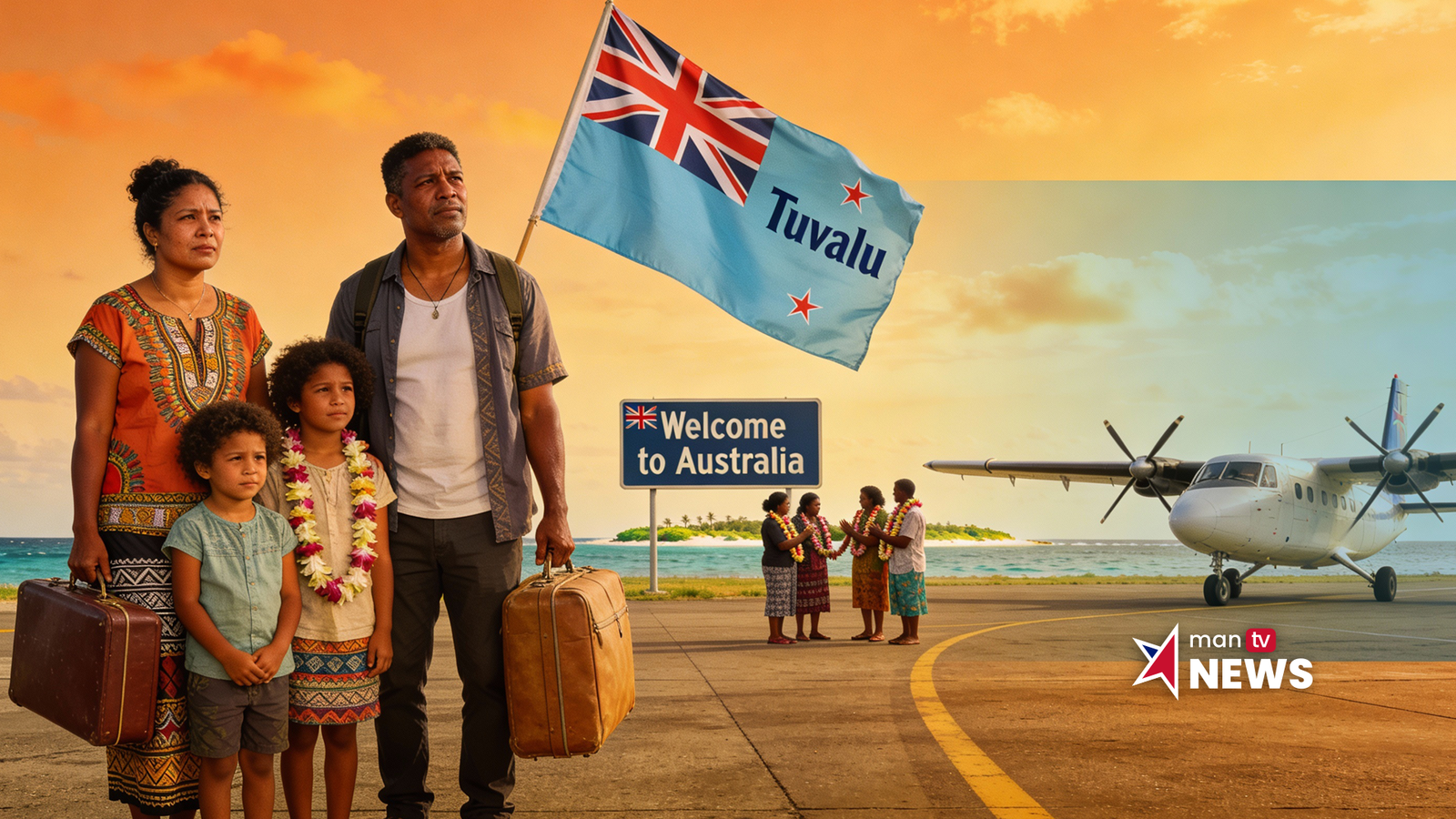
Tuvalu’s First Climate Migrants Begin New Lives in Australia Under Historic Mobility Pact
Australia has welcomed the first group of Tuvaluan climate migrants under a landmark mobility pact, marking a historic new chapter in the relationship between the sinking Pacific nation and its larger neighbour.
Landmark Tuvalu–Australia climate deal
Under a bilateral agreement signed two years ago, Tuvaluans can apply for special climate visas that allow them to live, work and study in Australia as rising seas threaten their homeland. More than one-third of Tuvalu’s roughly 11,000 citizens have applied, although the intake is capped at 280 visas a year to avoid a severe “brain drain” from the small island state.
Tuvalu is made up of low-lying atolls between Australia and Hawaii and is among the countries most at risk from sea-level rise. NASA projections suggest that by 2050, daily high tides could inundate half of Funafuti atoll, where about 60% of Tuvalu’s population lives, and a worst‑case scenario could see up to 90% of the main atoll underwater.
The first Tuvaluan families arrive
The first intake includes a cross-section of Tuvaluan society, from skilled workers to community and spiritual leaders. Among them are Tuvalu’s first female forklift driver, a dentist and a trainee pastor, all hoping to support families back home while building new lives in Australia.
Trainee pastor Manipua Puafolau, from the main island of Funafuti, has moved to Naracoorte in South Australia, where several hundred Pacific Islanders already work in agriculture and meat processing. He says the move is about more than jobs and safety, stressing the need for spiritual guidance and community support for Tuvaluans adjusting to life far from their ancestral land.
New lives in Australian cities
Forklift operator Kitai Haulapi, recently married, will settle in Melbourne and hopes to continue working in logistics while sending remittances back to her family in Tuvalu. She represents a generation of Tuvaluan women taking on new roles in both domestic and international labour markets.
Dentist Masina Matolu, who has three school‑aged children and a seafarer husband, is relocating with her family to Darwin in northern Australia. She plans to work with Indigenous communities and says she wants to bring skills and knowledge gained in Australia back to Tuvaluan culture, even as physical ties to the islands become harder to maintain.
Preserving culture as seas rise
On Funafuti, the physical vulnerability is stark: in many areas the atoll is barely wider than the road, families still live under thatched roofs, and children play football on the airport runway because of limited open space. As climate pressures intensify, Tuvaluan leaders are focused on ensuring that migration does not mean cultural erasure.
Prime Minister Feleti Teo recently met Tuvaluan communities in Melbourne, urging them to maintain strong ties to language, customs and community networks across borders. For many new arrivals, church, extended family and Tuvaluan community groups across Melbourne, Adelaide, Queensland and regional centres will be central to keeping identity alive in diaspora.
Australia’s role in “mobility with dignity”
Australian Foreign Minister Penny Wong has framed the climate visa pathway as offering “mobility with dignity”, recognising that Tuvaluans should not be forced into chaotic displacement as their islands become less habitable. The federal government is establishing support services in Melbourne, Adelaide, Queensland and regional hubs like Naracoorte to help families with housing, employment and settlement.
For Australia, the arrival of Tuvalu’s first climate migrants is both a humanitarian responsibility and a regional test case. As more Pacific nations confront severe climate impacts, the Tuvalu–Australia pact may become a model for managed, rights‑based climate mobility – one that protects people, skills and cultures, not just borders.


 English