






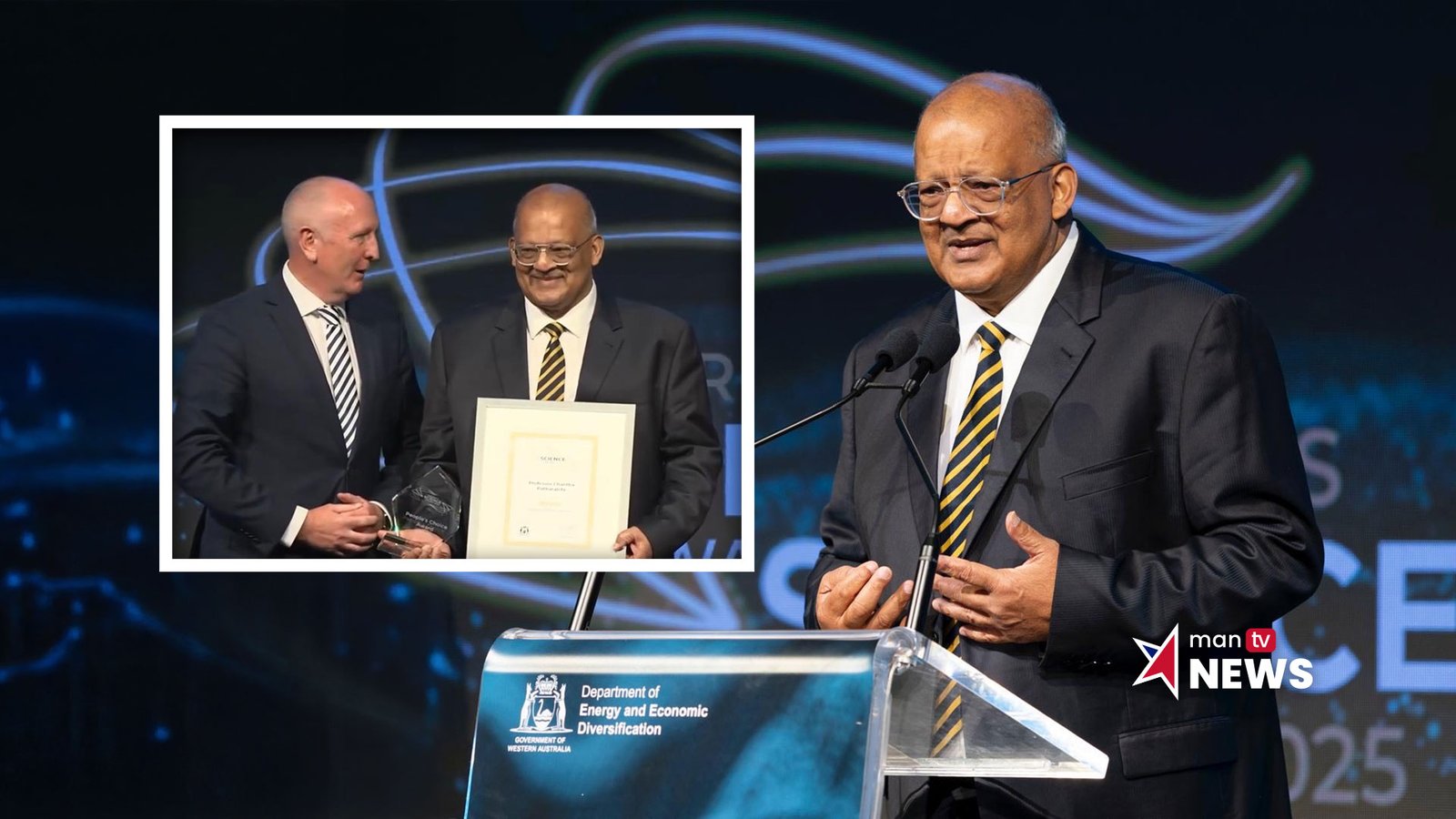
Professor Charitha Pattiaratchi: The ‘Best of the Best’ Drive Rewarded with People’s Choice Honor for Pioneering Oceanography
Professor Chari Pattiaratchi, a distinguished leader in the field of coastal oceanography and engineering at the UWA School of Engineering and the Oceans Institute, was recently recognized with the People’s Choice Award in the West Australian Premier’s Scientist of the Year Awards 2025. This significant achievement came after he was selected as a finalist for the main Scientist of the Year award, making him the first oceanographer to be a finalist for that award in the program’s 24-year history. This public mandate is a reward for his sustained effort over decades, rooted in the goal “to be the best of the best”. Professor Pattiaratchi is renowned for pioneering research, including major discoveries concerning dense shelf water transport, tsunami impacts, and the Leeuwin Current system, and for his dedication to mentorship, having supervised over 338 individuals, an effort that earned him The Oceanography Society Mentoring Award in 2024. His work is crucial for the practical application of science, contributing expertise to computer models that forecast tsunami threats, guiding major coastal projects in Sri Lanka, and resulting in recommendations that led to major government policy changes and costly design solutions in Western Australia.
In this Q&A, Professor Pattiaratchi reflects on the sustained drive behind his success, his role as a pioneer, and his continuous goal to consolidate his knowledge and solve ocean problems for the community.
Q: The Premier’s Science Awards are held to recognize outstanding research and
engagement taking place in Western Australia’s science, technology, engineering, and
mathematics (STEM) sector. How does it feel to have your work specifically recognized as
outstanding within the highly competitive STEM environment of Western Australia?
A: Well, it is, you know, as they say, it doesn’t come overnight. The achievement is really the result of striving to achieve what I call the phrase: to be the best of the best. This strive for excellent and outstanding performance basically started at school. I had a very interesting childhood because when I was born, I was very sick, and my life expectancy was only two years. I had many operations. I got over it, but with one handicap: I could not speak when I started school.
So, I started school unable to communicate with anyone, but then I turned into a highly active ADHD kid. Starting swimming as a competitive sport brought me discipline. The swimming culture is all about training, setting goals, and wanting to win. I was way ahead of everyone else in my events, so my only goals were to break records. Breaking a record means nobody has ever done that before, confirming that you are the best ever in that event . That is where the best of the best concept came from. This drive continued: when I was an undergraduate in the UK, I was the fastest swimmer in English and Welsh Universities, and I still play water polo competitively. This background carried into academia; whatever I do, I want to do it well, do it best, and be outstanding at what I do. So, this award is basically a reward for that sustained effort over decades.
Q: The 2025 awards selected 13 winners from a field of 38 finalists. Can you describe the
significance of being chosen as one of the winners among such a select group of
researchers and innovators?
A: The process began when the university recommended me, and a panel selected me as a finalist for the main award: Scientist of the Year. There were three finalists for that award, and though I was one, I did not win the main prize. However, being a finalist made me eligible for the People’s Choice Award, which is decided by a global public vote, and that is the award that I won. This victory was strongly backed by family, friends, former and current students and the Sri Lankan community in Perth, Australia, and worldwide.
This award is significant because it is a long-standing program, currently in its 24th year. In those 24 years, an oceanographer—or someone working in ocean science—had never been a finalist for the Scientist of the Year award. This achievement is important not only for me but for the entire field. I also noted that my whole life has been about being the first to do something, operating as a trailblazer. I am also potentially one of the first Sri Lankan persons to be a finalist in any Scientist of the Year award across Australia.
Q: The awards celebrated the achievements of winners as leaders of STEM in WA. In what
ways do you intend to leverage this recognition to further enhance or lead STEM initiatives
within the state?
A: I have been here 37 years and have achieved so much. This award is certainly a recognition, but I will not stop what I am doing, which involves discovery and mentoring people. The award essentially recognizes my role as a pioneer in the field. I have documented and covered virtually everything we know about how the ocean works in both Western Australia and around Sri Lanka. I intend to keep going, doing what I do best – solving ocean problems to the community. (As an aside, I am currently working hard to communicate that the whole of Sri Lanka is expected to face severe weather, heavy rain, and big waves in the next few days.)
Q: The Premier's Science Awards program reached its 24th year in 2025 and displayed
significant growth, including the addition of new categories. What does the continued growth
and prestige of these awards suggest about the current health and direction of STEM
research in Western Australia?
A: Western Australia is relevant in this context because it is one of the richest states in the world. This is due to its abundance of raw materials, including iron ore, gold, diamonds, aluminum, and critical minerals. Because it is a wealthy state, it is actively developing.
This wealth attracts major research infrastructure. For example, Western Australia is the home for the world’s most expensive research project—a €17 billion radio telescope funded mainly by the European Union. Because this project requires vast computing capabilities, I now have access to resources such as the fastest supercomputer in the Southern Hemisphere. This demonstrates that the whole STEM community benefits collectively by attracting infrastructure to Western Australia that individuals can readily tap into.
Q: How important is it that the Premier’s Science Awards actively serve as a vehicle for
demonstrating the valuable role that multiculturalism and diverse heritage play in advancing
Western Australia’s STEM sector?
A: Multiculturalism is not a selection criterion. While there is a focus on gender equality, I observe less emphasis on cultural equality. It is my observation that, apart from Indigenous people, there were very few non-Caucasian people present at the awards ceremony.
However, I have never found my heritage to be a disadvantage or a barrier to achieving what I want.
I am proud that I may be the first Sri Lankan to receive an award like this in Australia, but the
achievement is based solely on merit and is judged irrespective of who my heritage. I do not believe I had to overcome prejudice to get to this point.
Q: Beyond research, the program recognizes engagement. What role do you believe
scientists and researchers should play in actively engaging the community with their work in
STEM?
A: The essential role is the practical application of science. If you receive a tsunami warning via SMS on your phone, that technology exists because of the contributions of researchers and scientists, like myself. After being on the beach in Sri Lanka when the 2004 tsunami occurred, I made the tsunami a major part of my research focus. This application is centered on the safety of millions of people across the Indian Ocean rim. My scientific expertise contributes to the computer models that forecast when and where a tsunami will appear and its projected size.
In Sri Lanka, I have been involved in virtually every major coastal project, including advising on the Port City, working on sewage projects in Galle and Negombo, and conducting the Environmental Impact Assessment (EIA) for the Norochcholai power station. We also developed a fishing zone identification area 20 years ago that is still in use, and we issue forecasts for multi-day fishing boats, particularly for tuna. In Western Australia, my recommendations have resulted in major government policy changes and one design to solve a big problem cost $27 million Australian dollars. Beyond these practical applications, the role of a scientist also involves the transfer of knowledge by supervising and teaching many PhD and Master’s students, thereby training the next generation. This was recognised last year when I was the recipient of a Mentoring Award by the The
Oceanography Society, the main professional society in my field with the citation: For extraordinary mentoring of students and early career marine scientists in developed and underdeveloped nations.
Q: Now that you have received this significant honor, what is the next major challenge or goal
you are working toward in your area of expertise?
A: My wife suggested I retire after this honor, but I view the award as merely a road stop—I do not plan to stop what I am doing. Many of my crucial research moments were unplanned. I often find myself in a situation where something happens to me first. For example, after the 2004 tsunami, my research changed completely. Similarly, when the MH370 plane disappeared near the ocean where I am based, I became the focus of attention because I was the only oceanographer who could explain the dynamics. We used our computer resources to predict where the debris would surface in the western Indian Ocean, and I directed people to those areas, where the debris was ultimately found. Since major opportunities often arise spontaneously, my current primary goal is to consolidate all the knowledge I possess so that it is not solely contained in my head.
Q: For the upcoming generation of researchers and students in STEM, what advice would you
offer based on your experience that led to this recognition at the Premier’s Science Awards?
A: My advice is to take advantage of whatever opportunity comes in front of you. Do not spend too much time judging whether an opportunity is good or bad, as even a seemingly dead-end road can lead to a positive outcome. You must keep your eyes open, seize the opportunity, and leverage the uniqueness that you, as an individual, bring to the system. Finally, the biggest thing is that perseverance is important and always try to do the best you can. In the Australian sporting world PB is the goal – this stands for Personal Best thus this should be the aim of everyone that you strive to improve yourself.


 English